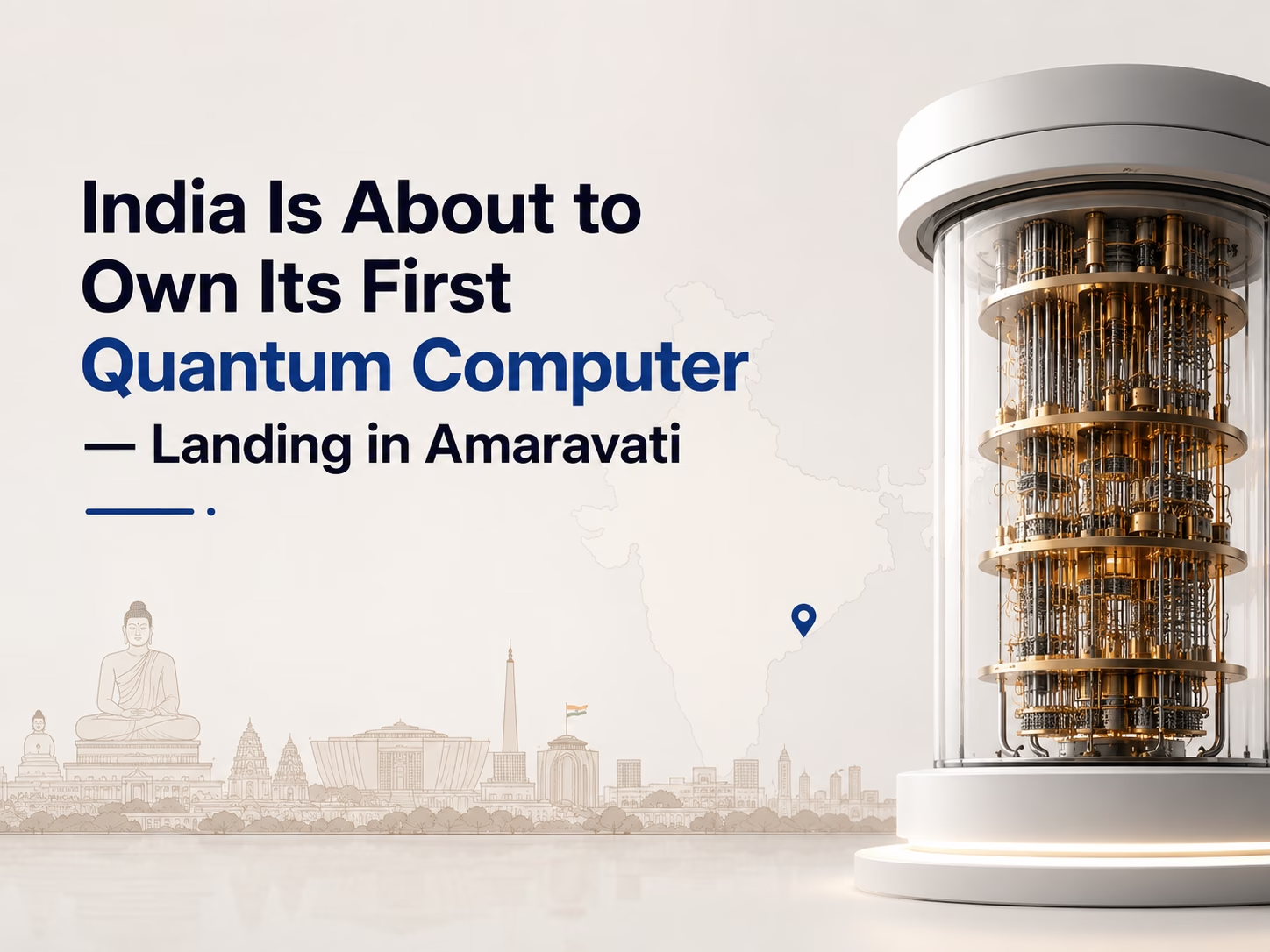
For years, Indian researchers who wanted to experiment with quantum computing had exactly one real option: log into a cloud dashboard and queue up time on hardware sitting in a data center on another continent. That’s about to change. IBM has confirmed it will install one of the first two physical IBM quantum computers on Indian soil in Amaravati, Andhra Pradesh’s greenfield capital, with the system targeted to go live by September 2026.
This isn’t a minor infrastructure footnote — it’s a genuine first for the country. Cloud access to quantum processors is useful, but it’s fundamentally different from having a machine physically sitting inside your own borders, available for hands-on research, startup experimentation, and sovereign capability building. Here’s everything that’s been confirmed so far: the hardware, the partnership behind it, why Amaravati specifically won this deployment, and what it actually means for India’s place in the global quantum race.
The Announcement: From “In Discussions” to a Confirmed Date
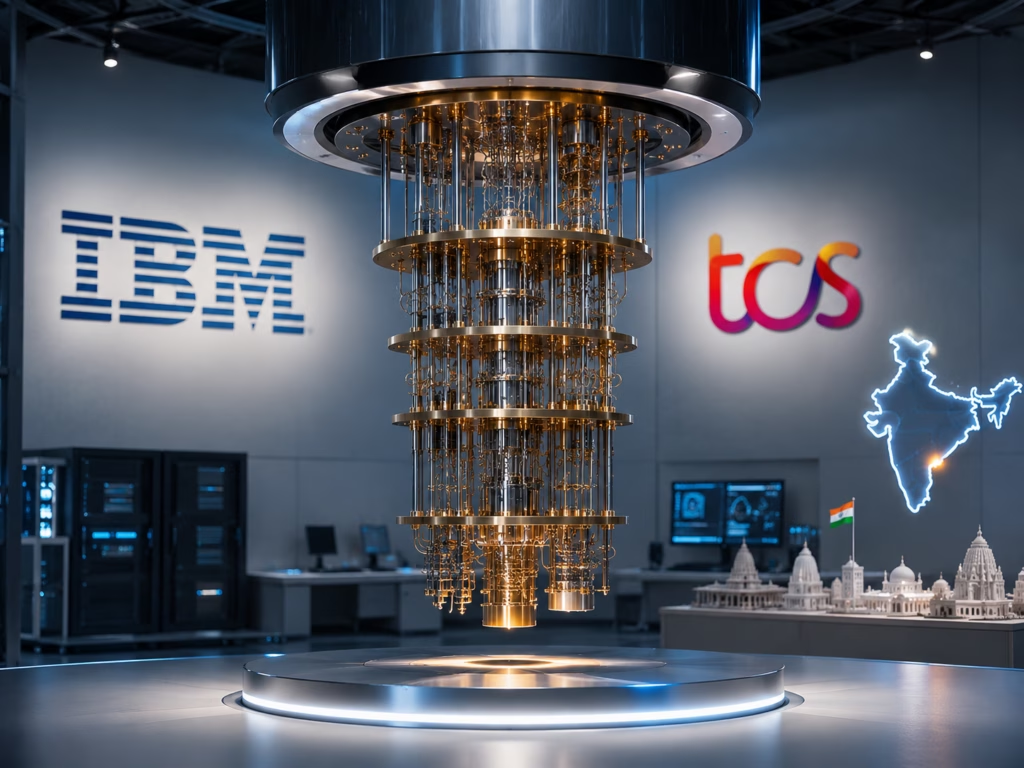
This story actually has two chapters. The groundwork was laid back on May 2, 2025, when IBM and Tata Consultancy Services jointly announced plans — via IBM’s own official newsroom — to anchor Andhra Pradesh’s new Quantum Valley Tech Park with an IBM Quantum System Two. At that stage, the language was still exploratory: IBM said it had “entered into discussions” with the state government, with the deployment explicitly described as being “as currently envisioned” and subject to export licenses and definitive agreements.
That changed on July 2, 2026, when IBM Chairman and CEO Arvind Krishna, speaking at an industry event in the United States, confirmed the concrete timeline: Amaravati would host one of the first two IBM quantum computers established in India, with commissioning now specifically targeted for September 2026. The announcement, carried by India’s Press Trust of India and widely reported by outlets including Business Today and The Print, marked the moment this project moved from “planned” to “dated.”
It’s worth being precise about what’s actually locked in versus what’s still pending. Per reporting compiled by Quantum Computing Report, the deployment still remains subject to standard international export licensing frameworks and final technical agreements before installation is actually complete — a routine but real caveat for any cross-border deployment of advanced computing hardware, and worth keeping in mind before treating September 2026 as an absolute guarantee rather than a strong, officially stated target.
The Hardware: What Exactly Is Being Installed?
The system planned for Amaravati is an IBM Quantum System Two, built around IBM’s Heron processor in a 156-qubit configuration. Per IBM’s own official announcement, this processor generation is specifically engineered for low gate-error rates and high fidelity — the two properties that matter most for actually getting useful, reliable results out of a quantum machine rather than noise.
If completed as planned, this would be the largest quantum computer in India, according to IBM’s own newsroom description of the project. That matters practically as well as symbolically: a larger, higher-fidelity qubit count means researchers can tackle more complex simulations and problem sets than they could on smaller demonstration systems.
Why Amaravati? Krishna’s Own Explanation
Andhra Pradesh didn’t win this deployment by accident. Speaking about the decision, Krishna pointed directly to the region’s talent pool as the deciding factor, explaining that the state offered a strong concentration of people trained in mathematics and physics — the two disciplines most directly relevant to translating real-world problems into quantum algorithms. It’s a specific, credible piece of reasoning: quantum computing bottlenecks aren’t really about the hardware alone, they’re about having enough people who actually know how to write meaningful problems for it.
That talent argument fits into a broader positioning push. Andhra Pradesh Chief Minister N. Chandrababu Naidu has been explicit about wanting Amaravati to become India’s “Quantum Capital,” and the state has branded itself the “Sunrise State” as part of a wider effort to attract emerging-technology investment across quantum computing, AI, green energy, and advanced manufacturing.
Not Starting From Zero: Amaravati Already Has Quantum Infrastructure
Here’s a detail that’s easy to miss in the headlines: Amaravati isn’t waiting until September 2026 to get its first taste of quantum hardware. In April 2026, the state government opened the Amaravati Quantum Reference Facility (AQRF) — described by Chief Minister Naidu as the first facility of its kind in India. AQRF houses two smaller systems, named Amaravati 1S and Amaravati 1Q, designed to let scientists, researchers, startups, and students study and experiment with quantum computing concepts, and to develop, test, and validate applications before they’re eventually run on larger systems like the incoming IBM installation.
In other words, the IBM System Two deployment isn’t arriving into a vacuum — it’s the flagship anchor for an ecosystem that’s already been quietly building up local capability for months. The formal Quantum Valley Tech Park initiative itself was launched at an inaugural summit in Amaravati in April 2026, giving the region a genuine head start on the surrounding infrastructure, training pipelines, and institutional partnerships a project like this actually needs to succeed.
The Partnership: A Trilateral Effort
This deployment isn’t just “IBM builds a computer in India” — it’s structured as a three-way collaboration, each partner playing a distinct role:
- Government of Andhra Pradesh — providing the Quantum Valley Tech Park site, policy backing, and the state-level push to build a dedicated innovation hub bringing together government, industry, academia, and startups.
- IBM — supplying the Quantum System Two hardware itself, along with its Qiskit software stack and broader quantum expertise.
- Tata Consultancy Services (TCS) — focused on the applications layer. Per IBM’s official announcement, TCS is developing quantum use cases across life sciences, materials science, supply chain resilience, energy optimization, cryptography, and sustainable manufacturing, and has separately signed an agreement enabling regional scientists and technologists to access IBM’s cloud-based quantum computers even ahead of the physical installation.
TCS’s Chief Technology Officer, Dr. Harrick Vin, has framed the company’s role around what it calls a “Hybrid Computing” strategy — building software that intelligently splits computational work across classical CPUs, GPUs, and quantum hardware depending on which architecture actually suits a given part of the problem, rather than treating quantum as a wholesale replacement for existing infrastructure.
The Bigger Picture: India’s National Quantum Mission
The Amaravati deployment doesn’t exist in isolation — it’s explicitly positioned as a flagship project under India’s National Quantum Mission, a roughly ₹6,000 crore government initiative aimed at making India a global hub in quantum computing, communication, and sensing. Chief Minister Naidu has directly tied the Quantum Valley Tech Park to this national mission’s goals of building innovation capacity and creating high-skill jobs.
The ecosystem around the mission is already substantial: reporting from Quantum Computing Report describes more than 50 partner organizations feeding into the broader effort, including major Indian engineering and technology players like Larsen & Toubro (L&T), the Centre for Development of Advanced Computing (C-DAC), and the Centre for Development of Telematics (C-DOT), alongside a range of academic institutions.
Why Physical Hardware Actually Matters (Not Just Cloud Access)
It’s worth pausing on why this distinction — physical installation versus cloud access — is being treated as such a milestone. IBM has offered cloud-based access to its quantum computers globally for years, including to Indian researchers through the TCS partnership. So what does having the actual machine on Indian soil change?
A few concrete things: hosting physical hardware gives local researchers and startups deeper, more hands-on experience with the technology’s real operational quirks — calibration, error correction, hardware-level debugging — rather than treating the quantum processor as a black box accessed purely through an API. It also shifts India’s position in the global quantum landscape from being solely a consumer of remote compute time to being a localized site of physical infrastructure — a meaningfully different footing when it comes to building sovereign technical capability, training a domestic quantum-literate workforce, and eventually developing India-specific intellectual property in the space.
Once operational, the plan is for enterprises, academic institutions, local startups, and independent researchers to all get direct access to run experiments and work on real industry problems using the machine — turning it into shared regional infrastructure rather than a single company’s private research tool.
Which Industries Are Expected to Benefit First?
According to Krishna’s own comments, quantum computing is roughly two to three years away from delivering genuinely significant commercial advantages, with the earliest meaningful impact expected across a specific set of sectors:
- Pharmaceuticals — modeling molecular interactions for drug discovery at a level of accuracy classical computers struggle to reach.
- Materials science — simulating novel materials computationally before they’re ever built physically.
- Financial services — portfolio optimization, risk modeling, and fraud detection.
- Logistics — solving complex optimization problems, like routing and supply chain resilience, at scales classical algorithms handle poorly.
- Cybersecurity — both a threat and an opportunity, since quantum computing has long-term implications for cryptography in both directions.
- Advanced AI — early exploration of quantum machine learning approaches to pattern recognition and model training.
That’s a genuinely broad spread of industries, and it’s worth noting none of them are framed as “solved” problems — Krishna’s own framing treats this as a two-to-three-year runway to commercial relevance, not an immediate transformation.
The Honest Caveats
It would be incomplete to cover this story without naming the uncertainty still built into it, because there’s real conditionality even in the confirmed announcement:
- Export licensing isn’t finalized. Quantum computing hardware is treated as sensitive, export-controlled technology by the U.S. government, and the deployment remains explicitly subject to standard international export licensing frameworks.
- Definitive technical agreements are still pending alongside the licensing process, per reporting on the arrangement.
- The second Indian location remains unconfirmed. IBM has said it’s in separate discussions to install a second quantum computer somewhere else in India, but that location hasn’t been finalized or announced.
- This is genuinely early-stage technology. Even optimistic industry framing treats broad commercial quantum advantage as still two to three years away — Amaravati’s system is meaningful infrastructure and a real head start, not a machine that will immediately start solving industry-scale problems on day one.
None of these caveats undercut the significance of the announcement — but they’re worth keeping in mind before assuming September 2026 is a guaranteed, unconditional date rather than a strong, publicly stated target that still depends on a few external approvals clearing on schedule.
Conclusion: A Genuine Milestone, With Real Work Still Ahead
Whatever happens with the exact timeline, the direction here is clear and significant: India is moving from being a remote consumer of quantum cloud time to becoming a host of real, physical quantum infrastructure — and Andhra Pradesh, through a combination of early government commitment, a dedicated Quantum Valley initiative, and a talent-pool argument IBM’s own CEO found compelling enough to bet on, has positioned itself at the front of that shift within India.
The Amaravati deployment is best understood as a foundation-laying moment rather than a finish line. The AQRF’s smaller systems are already running, the Quantum Valley Tech Park ecosystem is already assembling its 50-plus partner network, and a 156-qubit IBM Quantum System Two is now on a stated path to going live by September 2026. If it lands on schedule, Amaravati won’t just have a powerful new machine — it’ll have a genuine head start on training the generation of Indian scientists, engineers, and entrepreneurs who’ll actually decide what India’s quantum future looks like.
Sources
- IBM, Tata Consultancy Services and Government of Andhra Pradesh Unveil Plans to Deploy India’s Largest Quantum Computer in the Country’s First Quantum Valley Tech Park — IBM Newsroom, May 2, 2025
- IBM, Tata Consultancy Services and Government of Andhra Pradesh to Deploy India’s Largest Quantum Computer — TCS Newsroom, May 2, 2025
- Amaravati to host IBM quantum computer, commissioning by Sep 2026: CEO Arvind Krishna — PTI, via The Print, July 2, 2026
- IBM to brings its first Quantum Computer to Amaravati: CEO Arvind Krishna — Business Today, July 2, 2026
- IBM to Commission One of India’s First Physical Quantum Computers in Amaravati by September 2026 — Quantum Computing Report
This deployment is still subject to export licensing and final technical agreements as of this writing — worth a quick check for updates closer to publishing, given how quickly this story has been evolving.