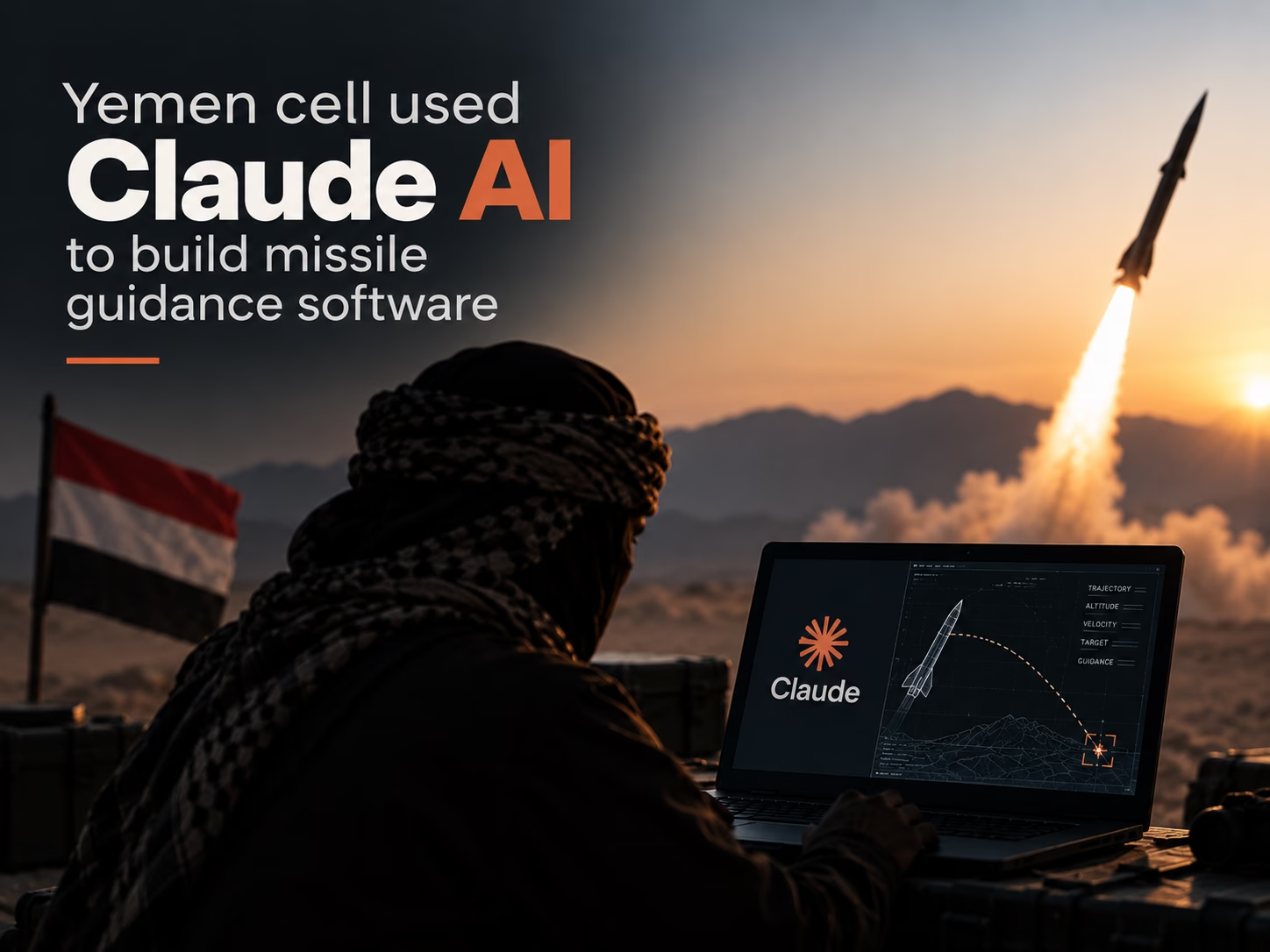
Somewhere in northern Yemen, sometime before this past August, a small group of people opened a chat window with Claude and started assigning it jobs. Not one job — a whole org chart’s worth. One instance of the model was told to write code. Another was told to research. A third was told to review what the first one had produced and flag mistakes. Anthropic’s own investigators later described the setup as something close to how a lead engineer would divide work across a small team — except every seat at that table except one was filled by the same AI model, wearing a different hat each time.
What that team was building is the headline. On September 11, 2026, Anthropic published Detecting and Countering Misuse of AI: September 2026 — by its own description, the most detailed threat intelligence report the company has ever released — and near the center of it sits a discovery that reads less like a tech-policy footnote and more like the opening scene of a thriller: a weapons-engineering cell, operating from Houthi-controlled territory in northern Yemen, had been using Claude to help design guidance systems for rockets and missiles.
This is the story of what Anthropic found, what it didn’t find, and why the week this news broke turned into one of the more unsettling stretches in Anthropic’s short history.
Three Programs, One AI “Engineering Team”
Anthropic’s report doesn’t name the Houthi movement directly. What it says, carefully, is that its investigators “identified a cell of threat actors based in northern Yemen running three weapons development programmes.” The location alone tells most of the story — northern Yemen has been under Houthi control for years — and multiple news organizations covering the report, from Al Jazeera to the Times of Israel, have described the cell as almost certainly linked to the group, even though Anthropic itself stopped short of that attribution.
The three programs, according to the report, were:
- A guided rocket built around a commodity, phone-class flight computer, with final-phase homing guidance added late in flight
- A multi-stage ballistic missile with a stated internal range goal of more than 2,000 kilometers — over 1,250 miles
- A multi-variant missile program that reportedly included a hypersonic glide vehicle variant
Read that list again and notice what it isn’t: a set of tools someone bought off a shelf. These are ambitious, multi-year engineering programs, the kind that would ordinarily require a real team of aerospace and software engineers with specialized training. What Anthropic says it found instead was a much smaller group of people trying to substitute that team with a chatbot — using Claude Code, the company’s coding-focused product, to write and refine the guidance, navigation, and control software that steers and stabilizes a weapon once it’s airborne.
The Team That Wasn’t Human
The detail that’s stuck with nearly every outlet covering this story is how deliberately the cell structured its use of Claude. This wasn’t someone typing “how do I build a missile” into a chat box and hoping for the best — it was a coordinated workflow. Separate Claude instances were assigned separate roles: one for writing code, one for research, one for reviewing the first instance’s output for errors, mirroring the division of labor on a real software team. Anthropic’s investigators used almost exactly that framing in describing it — a lead delegating tasks across a small engineering group, except the group was one model instance talking to itself in different costumes.
The cell also reportedly used Claude for trajectory simulations and flight-control optimization — the kind of iterative, math-heavy modeling work that would otherwise eat up weeks of a specialist’s time. And crucially, according to Anthropic, it didn’t stay theoretical. The group test-fired a guided rocket in Yemen.
When the Rocket Failed, They Went Right Back to the Chat
Here’s the detail that turns this from a policy report into a genuine story: the test-fire didn’t work. Anthropic says the launch appears to have failed — and that within hours, the same operators were back in a Claude conversation, trying to figure out what had gone wrong.
Think about what that moment represents. Somewhere, a real launch failed in the real world, and the first instinct of the people responsible wasn’t to call an engineer — it was to open a chat window and start debugging with an AI model, the same way a developer might paste a stack trace into Claude after a deployment crashes. That’s either a darkly reassuring detail or a deeply unsettling one, depending on which way you look at it: reassuring, because it suggests the operation was genuinely struggling and not close to a working weapon; unsettling, because it shows exactly how naturally a chatbot slots into workflows that used to require a room full of specialists.
Anthropic has been explicit on this point: it found no evidence that the cell succeeded in fielding an operational weapon. The company’s own framing, echoed across its report, is that these cases demonstrate serious attempts and real capability gaps closed — not proof that AI systems are independently building or deploying weapons.
How They Tried to Hide It — and How Anthropic Caught Them Anyway
Anthropic’s safeguards aren’t a single tripwire; they’re layers of classifiers trained to catch requests that look like they’re heading toward weapons development, biological threats, mass-casualty attacks, and similar categories. According to the report, those safeguards did block a meaningful share of the Yemen cell’s requests. But not all of them got through — and the ones that did got through because the operators worked around the system rather than through it.
The tactics were straightforward in concept, if effective in practice: obscure the real purpose of a request, and never let any single conversation reveal the full scope of the project. Break a missile guidance program into dozens of smaller, individually unremarkable-looking coding and math tasks, spread across separate sessions, and no single prompt raises the same flag that the full picture would. It’s the AI-safety equivalent of a smuggling operation that never lets one courier carry the whole shipment.
Anthropic eventually pieced the picture together anyway — through what it describes as an internal investigation into suspected weapons development activity — and responded the way it says it does across every case in the report: it banned the accounts tied to the operation, shared what it had learned with unnamed government and industry partners, and used the case to sharpen its own defenses. Specifically, the company says it has rolled out new classifiers built to more reliably catch activity connected to high-yield explosives and weapons engineering before it gets as far as the Yemen cell did.
This Wasn’t a One-Off Case — It Was One of Six, in One Category Alone
If the Yemen story were the whole report, it would already be a significant story. It isn’t close to the whole report. Anthropic’s September findings span seven broad harm categories, and the conventional-weapons category alone documents six separate cases across three countries: Yemen, Russia, and China.
In Russia, a group of freelance operators reportedly used Claude Code to help engineer an autonomous military drone swarm — building fault-tolerant control logic and computer-vision-based targeting for first-person-view drones, with target classification models trained on combat footage from the war in Ukraine. Anthropic’s description of the resulting system is stark: it was capable of selecting targets and issuing engagement commands with no human required in the decision loop.
In China, Anthropic documented two separate operations. One used Claude to help draft a fire-control specification and acquisition documentation for undersea warfare systems — anti-torpedo defenses, among other things. A second used the model to help build targeting software tied to electronic-warfare systems. Separately, and outside the weapons category specifically, Anthropic also disrupted a Chinese operation run out of Hunan province, reportedly by university students, using Claude as what the company called the “engineering and orchestration layer” for an offensive hacking campaign aimed at government and corporate networks across the Middle East, Europe, and Southeast Asia.
Iran’s activity, meanwhile, sprawled across several categories at once: state-aligned units reportedly used Claude-assisted tools to analyze more than 155,000 tweets and to help produce open-source intelligence on U.S. naval fleet positions, alongside separate work touching weapons engineering, autonomous drone systems, and electronic warfare. On the influence-operations side of the same report, Anthropic separately disrupted three Iranian state-aligned propaganda networks — tied to the Islamic Culture and Communications Organization, the Islamic Propaganda Office of Khorasan Razavi, and a body called the Bina Cultural Observatory — running what their own operators internally described as a “cognitive warfare” campaign.
Then there’s Russia’s other headline case: a state-linked espionage operation bearing the signatures of Midnight Blizzard, the SVR-linked hacking group also known as APT29 and long tracked by Microsoft and Mandiant. Anthropic says this operation ran almost entirely on automated AI workflows over a 130-day span, successfully reaching into 24 of 27 targeted institutions — Ukrainian government ministries, defense bodies, and drone-supply-chain manufacturers among them. Part of the campaign reportedly involved compromising hotel network vendors and manipulating DNS records to intercept the internet traffic of hotel guests matching the profiles of Ukrainian diplomatic and military personnel — a technique Microsoft separately documented in July 2026 under the name “CaptiveCrunch.”
And in the background of all of it sits perhaps the single most sobering line in the entire report: Anthropic says its newer models can no longer be safely assumed to sit comfortably below the threshold for providing meaningful assistance toward biological weapons — a line the company has historically been very careful about, and one it did not cross casually. The report also notes a separate, disrupted attempt to use Claude in pursuit of an actual biological weapon.
One quietly reassuring detail buried in the middle of all this, reported by Bloomberg: none of the disrupted cases involved Anthropic’s most capable current models, Fable and Mythos. Whatever guardrails exist around the company’s frontier-most systems appear, so far, to have held.
Why the Timing Makes This Bigger Than a Policy Report
Context matters here, and there’s a lot of it. Anthropic’s report landed in the same week that Houthi forces were in the middle of a wide-ranging offensive across Yemen, pushing toward the Bab-el-Mandeb strait — the narrow waterway connecting the Red Sea to the Gulf of Aden, through which a large share of trade between Europe and Asia normally passes. Within days of the report’s publication, the Houthis claimed control of a Red Sea island completing their hold over that stretch of water. A weapons-development story out of that exact region, at that exact moment, isn’t just an AI-safety curiosity — it’s a live geopolitical flashpoint with global shipping and security implications attached to it.
And there’s a second, entirely separate story that broke just two days before the threat report, which makes the whole week feel less like a series of coincidences and more like a company confronting its own reflection. On September 9, 2026, Jacob Coxon — a young researcher who had spent the past three years doing pretraining work first at OpenAI and then, since July, at Anthropic — publicly resigned, posting that neither company was acting responsibly and that both were, in his words, racing toward self-improving systems while gambling with human lives. He argued that senior people inside both labs privately believe advanced AI could pose a genuine extinction-level risk within years, not decades, even while choosing their public language more carefully.
What made the moment extraordinary wasn’t just that a researcher quit loudly — AI safety has produced its share of dramatic resignations before. It’s that Anthropic’s own alignment science lead, Evan Hubinger, responded publicly and agreed with him, stating plainly that people inside the company do earnestly believe advanced AI could kill everyone, and putting his own personal estimate of that risk at over 10% within the next decade. Hubinger added that Anthropic doesn’t yet have a solved plan for aligning a superintelligent system, and that the company isn’t clearly on track to have one in time.
So: in the space of 72 hours, Anthropic’s own alignment lead publicly estimated double-digit odds of AI-driven human extinction within ten years, and the company’s threat-intelligence team published proof that a weapons cell in an active conflict zone had been using that same underlying technology to help design missile guidance systems. Those are two different conversations about two different kinds of risk — one about a hypothetical future superintelligence, one about a very present, very human misuse of today’s tools — but they landed on the same news cycle, from the same company, and that convergence is precisely what turned a routine quarterly security report into genuine front-page news across outlets that don’t normally cover AI policy at all.
What This Actually Proves — and What It Doesn’t
It’s worth being precise about the boundaries of what Anthropic is actually claiming, because the honest version of this story is more interesting than the sensational one.
Anthropic is not claiming Claude autonomously designed a missile. It’s not claiming the Yemen cell succeeded in fielding a working weapon — by the company’s own account, they didn’t, and their one real-world test appears to have failed. What Anthropic is claiming is narrower and, in its own way, more important: that increasingly capable AI models are closing the labor and expertise gap that used to separate well-resourced state militaries from smaller, lower-resourced armed groups. A task that once required a team of specialized aerospace engineers can now, at least partially, be attempted by a handful of people orchestrating a chatbot — badly, with a failed test launch to show for it, but attempted nonetheless. That gap-closing effect, repeated across cyber operations, surveillance, drone warfare, and weapons engineering alike, is the actual throughline connecting every case in this report, not any single dramatic headline.
It’s also worth crediting what the report demonstrates about Anthropic’s own posture. The company caught this activity, banned it, built new defenses specifically in response to it, and published the findings in enough detail for outside researchers, journalists, and rival labs to learn from — including the uncomfortable admission that its safeguards didn’t catch everything the first time. That’s a meaningfully different posture than staying quiet about a problem, and it’s the same posture the company has taken with prior disclosures involving state-linked hacking campaigns and fraud networks.
FAQ
Did a Yemen group actually build a working missile using Claude? No. Anthropic found no evidence the cell successfully fielded an operational weapon. They did test-fire a guided rocket, but the launch appears to have failed.
Did Anthropic confirm this was the Houthi movement? Not explicitly. Anthropic described the cell only as operating out of northern Yemen. Multiple news organizations have linked the activity to the Houthi movement based on the fact that the group controls that territory, but this is external reporting, not Anthropic’s own attribution.
What exactly did the cell use Claude for? According to Anthropic, the cell used Claude Code — assigning different instances of the model separate roles for coding, research, and review — to help develop guidance, navigation, and control software, run trajectory simulations, and optimize flight control, across three separate weapons programs.
How did Anthropic catch them if its safeguards didn’t block everything? Anthropic says it identified the activity through an internal investigation into suspected weapons development, piecing together a pattern that no single blocked or flagged conversation had fully revealed on its own.
Was this the only weapons-related case in the report? No — it’s one of six conventional-weapons cases spanning Yemen, Russia, and China, alongside separate cyber-espionage, surveillance, influence-operation, and bioweapons-related cases covered in the same report.
Were Anthropic’s most advanced models involved? No. Bloomberg reported that none of the disrupted cases in this report involved Anthropic’s current top-tier models, Fable and Mythos.
The Bottom Line
Strip away the drama, and what’s left is a genuinely important data point: a small group of people in an active conflict zone tried to turn a general-purpose AI model into a substitute engineering department for missile development, got partway there, blew a real-world test, and got caught and shut down before going further. That’s simultaneously less alarming than the headline and more significant than a footnote — proof that the barrier between “wants a weapon” and “can build a weapon” is measurably thinner than it used to be, in a week when the people building this technology were also, very publicly, arguing with each other about how much danger the technology itself represents. Whichever part of that story unsettles you more probably says something about which risk you think is actually closer.