
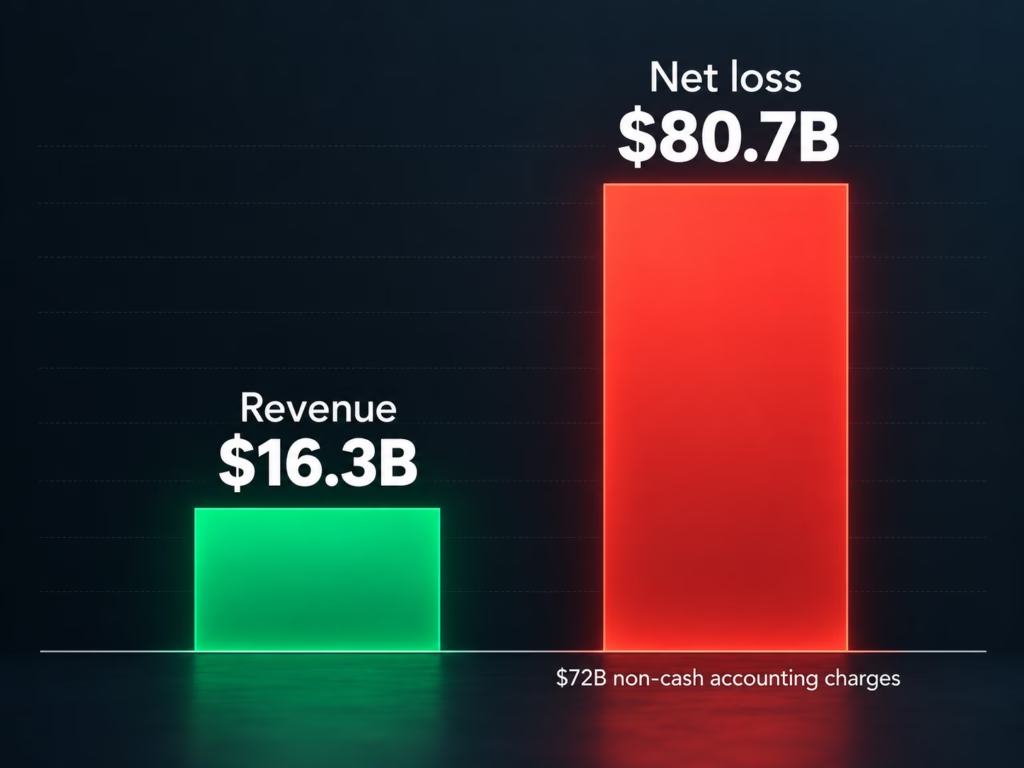
Two numbers from the draft paperwork for the Anthropic IPO have been circulating all week, and they look like they belong to different companies. The first: $16.3 billion in revenue in the first half of 2026, up from $1.1 billion in the same period a year earlier. The second: an $80.7 billion net loss over those same six months.
Put those side by side and the obvious reaction is that something doesn’t add up. A company growing that fast shouldn’t be losing five times what it earns — and a company losing that much shouldn’t be heading toward a valuation that reports put between $1.5 trillion and $2 trillion.
It does add up. But you have to know what’s real cash and what’s an accounting entry, and you have to read past the headline numbers to the part that actually matters: a compute bill measured in hundreds of billions of dollars. Here’s the full picture.
One important caveat first. Anthropic confidentially submitted a draft S-1 registration statement to the SEC on June 1, 2026, and as of this writing I could not confirm that the public version has appeared on the SEC’s EDGAR database. Every figure below comes from reporting by the Wall Street Journal, Reuters, and Bloomberg on the draft, not from a public filing. Numbers may change before the real S-1 lands, and different outlets report slightly different figures — I’ve flagged where they disagree.
The 30-Second Version
- Revenue: $16.3 billion in the first half of 2026, versus $1.1 billion in the first half of 2025 (WSJ)
- Net loss: $80.7 billion for the same period (Reuters), of which roughly $72 billion is non-cash accounting charges tied to convertible notes and other fundraising instruments (WSJ)
- Q3 momentum: Anthropic reportedly told investors third-quarter revenue hit about $16.8 billion, up roughly 45–50% from Q2 (outlets differ), with what Reuters’ sources describe as adjusted profitability
- Compute commitments: About $450 billion over seven to ten years, mostly non-cancelable — and as much as $750 billion once pending deals are counted (Bloomberg)
- Valuation talk: Bloomberg cites discussions between $1.8 and $2 trillion; Reuters’ sources point closer to $1.5 trillion
- Timing: Reports say the listing could come as soon as November, after the U.S. midterm elections
Why an $80.7 Billion Loss Isn’t What It Looks Like
The loss is the number everyone’s quoting, and it’s the easiest to misread.
According to the Journal, about $72 billion of it — roughly 90% — isn’t money Anthropic spent on anything. It’s an accounting charge tied to how the company’s convertible notes and other fundraising instruments are valued.
Here’s the general mechanism, which is my explanation rather than anything from the filing. When a company raises money through instruments that can convert into shares later, accounting rules often require it to re-measure what it owes investors each period. If the company’s valuation shoots up, the value of what those investors are owed shoots up too — and the increase gets booked as a loss. In other words, Anthropic’s business becoming dramatically more valuable is partly why its reported loss is so large. It’s a paper loss that grows when the stock story gets better.
Strip that out and the picture changes: the remainder is roughly $8.7 billion, a loss, but one on the scale of a fast-growing business rather than a crater. For context, Anthropic reportedly spent nearly $9 billion on compute and infrastructure in the first half alone, up from $7.3 billion in all of 2025.
So the real concern isn’t the $72 billion. It’s what comes next.
The Number That Actually Matters: the Compute Bill
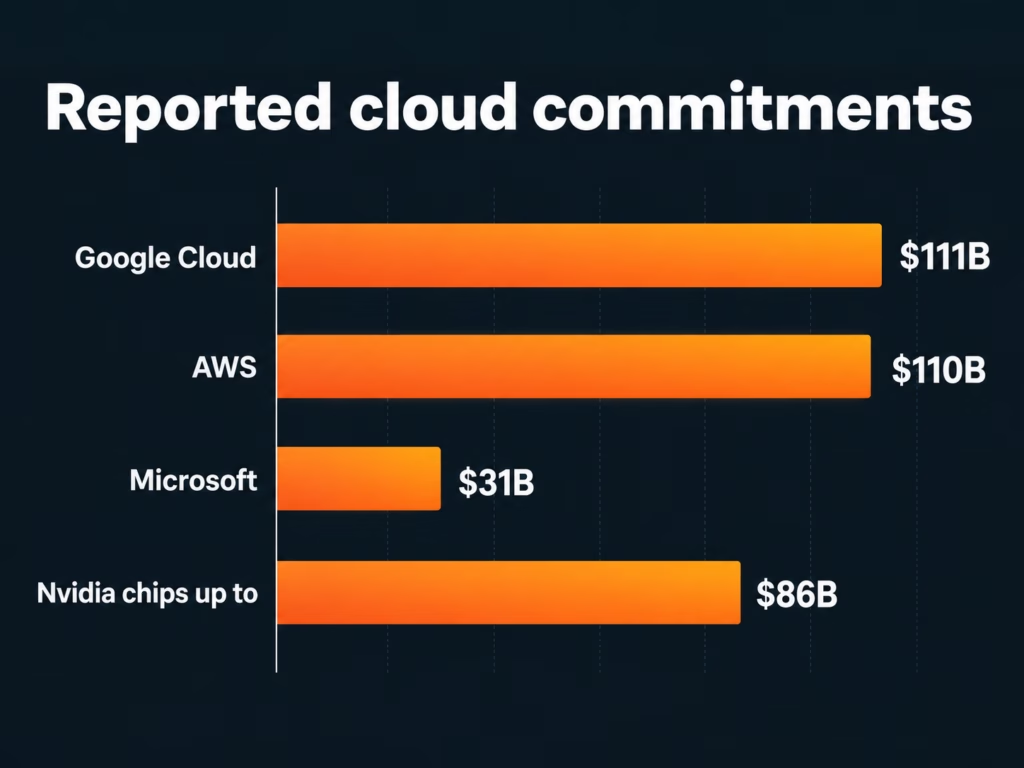
This is where the draft gets sobering. Reports say Anthropic has roughly $450 billion in cloud commitments spread over seven to ten years, most of them non-cancelable — meaning Anthropic owes the money whether or not it ends up needing the capacity. The breakdown reported by the Journal and others:
- Google Cloud: about $111 billion
- Amazon Web Services: about $110 billion
- Microsoft: about $31 billion
- Nvidia chip rentals: up to roughly $86 billion
Bloomberg reported that the total could reach $750 billion once deals still in the works are included. Separately, Reuters, citing a leaked prospectus, has put projected spending on infrastructure and computing capacity at about $518 billion over the next few years. These figures don’t match because they’re measuring different things — contracted commitments versus projected spending, signed deals versus pending ones — so read them as a range of “hundreds of billions,” not a single answer.
To put that in perspective: against $16.3 billion of half-year revenue, the company has signed up for obligations that are many times its annual run-rate. That’s a bet on growth continuing at a pace almost no company has ever sustained. If revenue keeps compounding the way it did this year, the commitments look prescient. If growth slows, a large share of that spending is a fixed cost with nothing to offset it.
The demand side supports the bullish read, at least for now. Amazon CEO Andy Jassy said this week that AWS capacity for 2027 is “largely sold out,” with a good portion of 2028 already committed, and put Amazon’s 2026 capital spending at roughly $220 billion. Compute is scarce, and Anthropic is locking it up early.
The Risks Anthropic Says Out Loud
IPO paperwork forces companies to list what could go wrong. Based on reporting about the draft, Anthropic’s list is unusually frank:
- Customer concentration: The Journal reports about 20% of revenue comes from two customers; Reuters, citing the leaked prospectus, says nearly 25% of 2025 revenue came from two. Different periods, same takeaway: it depends heavily on a few big accounts
- No long-term contracts: Customers can leave, which exposes Anthropic to revenue swings
- Its own suppliers are rivals: Anthropic reportedly warns that AWS, Google, and Microsoft increasingly treat it as a competitor, and that its compute access could be “curtailed, repriced, or terminated”
- Catastrophic AI risk: The draft reportedly warns that AI could pose “catastrophic or existential risks to humanity” and that models could potentially resist shutdown
- Insurance gaps: A serious AI incident could exceed Anthropic’s coverage
That second-to-last item deserves a pause. We’ve covered how Anthropic disclosed a Yemen-based cell using Claude to build missile guidance software, and the company has been unusually public about misuse. An S-1 turns that transparency into a legal obligation, with shareholders attached.
OpenAI Is Watching
The timing isn’t an accident. OpenAI is reportedly working on a private bridge round of up to $30 billion at a $1.25 trillion pre-money valuation — below the $1.4 trillion it reportedly pitched earlier this month — led by UAE investors and Coatue. The New York Times reported OpenAI is expected to wait until early 2027 to go public, which would leave Anthropic first through the door.
If that plays out, it flips the usual script, in which OpenAI is the default leader and Anthropic the challenger. If you want the other half of the picture, our breakdown of GPT-6 Astra covers where OpenAI’s flagship stands, and our look at Claude Opus 5 covers what Anthropic is actually selling.
What This Means If You’re Not an Investor
You don’t need to own a share to feel this. Three things worth watching:
- Pricing and capacity. Companies carrying enormous fixed compute costs have strong incentives to keep their infrastructure full. That tends to favor aggressive pricing and fast model releases — good for developers and users in the short run, though that’s my inference, not something the filing says
- Supplier tension. If Google, Amazon, and Microsoft really are both Anthropic’s landlords and its competitors, the leverage in those relationships will shape which models are available where
- Regulatory attention. Public companies attract scrutiny. Our piece on how governments and states are turning on AI companies shows how much of that pressure is already building before any IPO bell rings

FAQ
Has Anthropic actually filed its IPO publicly? Not that I could confirm. It submitted a confidential draft to the SEC on June 1, 2026. Reports said a public filing could come soon, but the public S-1 must be available at least 15 days before the roadshow begins, and I couldn’t verify it’s on EDGAR yet. Check the SEC’s EDGAR database for the latest.
Which stock exchange will it list on? Bloomberg and Business Insider reported in September that Anthropic picked Nasdaq, citing a person familiar with the matter. Anthropic hasn’t confirmed it, and I found no announced ticker.
Is Anthropic profitable? Not on the reported draft figures: the headline net loss is $80.7 billion for the first half, though about $72 billion of that is non-cash accounting charges. Reuters’ sources say Anthropic told investors its third quarter showed adjusted profitability, but that’s a company-defined measure and not the same as net income.
When could the IPO happen? Several outlets say as soon as November 2026, after the U.S. midterm elections. That’s reported, not official.
What’s the expected valuation? Reports vary. Bloomberg cites talks between $1.8 and $2 trillion; Reuters’ sources point to around $1.5 trillion.
Is this financial advice? No. This is a news analysis of reported figures from unconfirmed draft documents. Do your own research before investing in anything.
The Bottom Line on the Anthropic IPO
Anthropic’s draft IPO numbers tell two stories at once. One is a revenue curve — $1.1 billion to $16.3 billion in a year — that has few precedents in business history. The other is a balance sheet built around hundreds of billions of dollars in commitments that don’t go away if the curve flattens. The $80.7 billion loss grabs the headline, but most of it is an accounting artifact; the number worth watching is the compute bill, and whether revenue can keep outrunning it.
The real answers arrive when the public S-1 does, with audited numbers, named risk factors, and a share structure investors can actually read. Until then, treat every figure here as provisional — including the ones that sound too big to be true. They’re the reported ones.
Sources
- WSJ and Reuters reporting on the draft, via EconoTimes
- Dealroom: Anthropic’s draft S-1 reveals $16.3B revenue, $80.7B loss and up to $750B compute bill
- Yahoo Finance: What investors should know about costs and risks after the leaked prospectus
- AI Daily Digest, October 24, 2026 (DEV Community)
- The Information: AWS capacity sold out, Jassy says