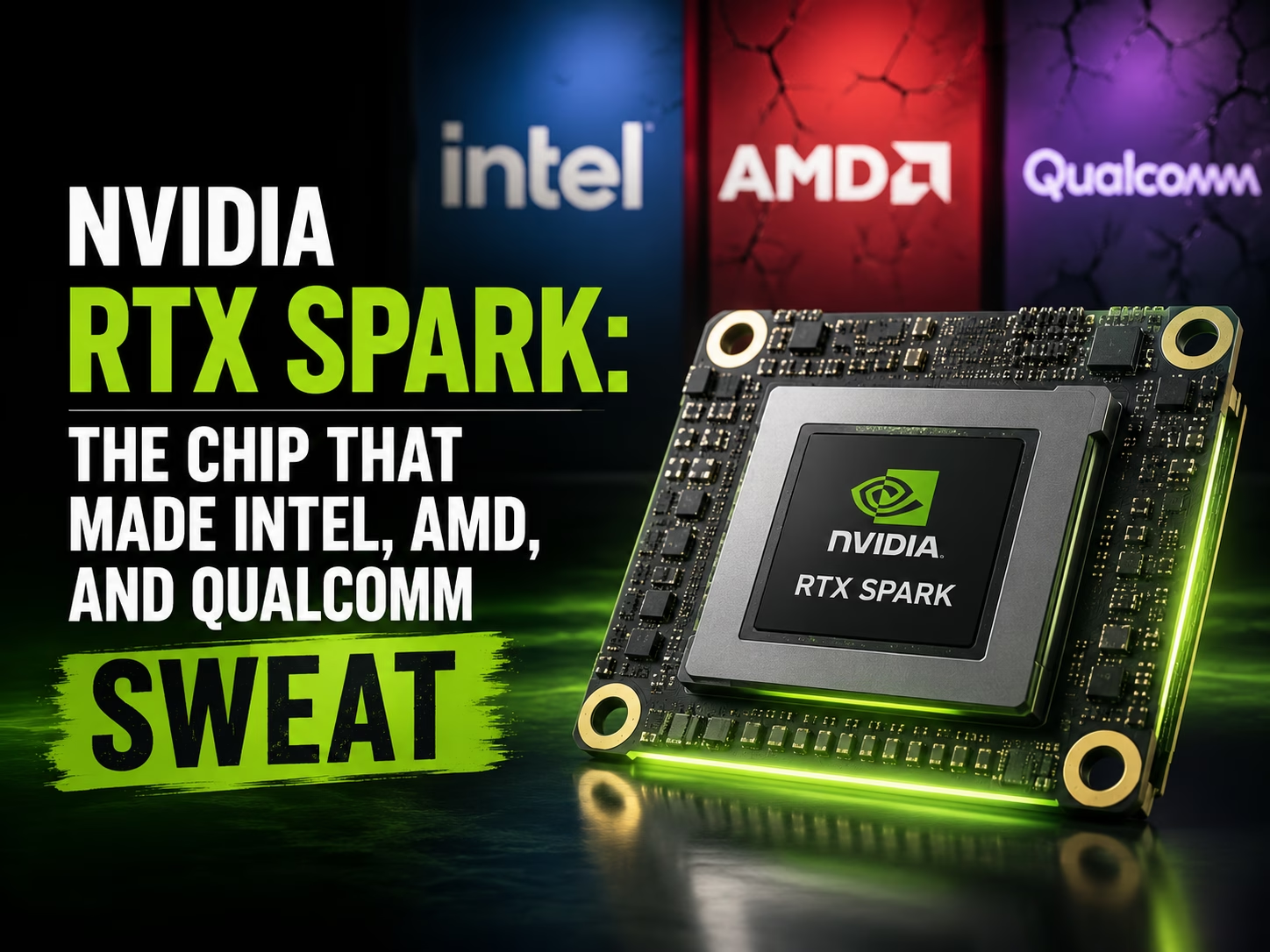
On June 1, 2026, Jensen Huang walked onto a stage in Taipei and, within about twenty minutes, wiped roughly $80 billion in combined market value off three of the world’s biggest chip companies. He didn’t announce a new gaming GPU. He didn’t announce a new data-center accelerator. He announced a laptop chip — and Wall Street reacted like NVIDIA had just declared war on the entire Windows PC industry, because in a lot of ways, it had.
That chip is called RTX Spark, and it’s the strangest, boldest thing NVIDIA has shipped in years: a single piece of silicon that fuses a full CPU and a genuinely powerful GPU together, built for a future where you don’t launch apps so much as you talk to your computer and let AI agents do the launching for you. It’s already forcing three uncomfortable questions onto anyone shopping for a laptop this fall: Is Intel in trouble? Does this make dedicated RTX graphics cards pointless? And can you finally, safely, buy a laptop without a discrete GPU and not feel like you compromised?
Let’s dig into all of it.
What Is NVIDIA RTX Spark, Actually?
RTX Spark is what NVIDIA calls a “superchip” — not a CPU, not a GPU, but both fused onto one package. Specifically, it pairs a 20-core Arm-based Grace CPU (co-designed with MediaTek) with a Blackwell RTX GPU carrying 6,144 CUDA cores and fifth-generation Tensor Cores, connected through NVIDIA’s NVLink-C2C interconnect. Both sides share a single pool of up to 128GB of unified LPDDR5X memory, which is the real party trick: instead of your CPU and GPU each getting their own separate, smaller memory pool, they draw from the same enormous one.
The headline number NVIDIA keeps repeating is 1 petaflop of FP4 AI compute, aimed squarely at running large AI models and autonomous agents directly on your device instead of in the cloud. NVIDIA and Microsoft have been building this together for a while, right down to a new Windows security layer called NVIDIA OpenShell designed specifically to let AI agents run and act on your PC without turning your machine into a security nightmare.
Here’s the quick-reference spec sheet:
| Spec | RTX Spark (N1X, flagship) | RTX Spark (N1, efficiency tier) |
|---|---|---|
| CPU | 20-core Arm (Grace, w/ MediaTek) | 10–12 core Arm |
| GPU | Blackwell, 6,144 CUDA cores | Up to 2,048 CUDA cores |
| AI compute | Up to 1 petaflop (FP4) | Lower, unannounced |
| Memory | Up to 128GB unified LPDDR5X | Up to 64GB |
| Power envelope | 45–80W | 18–45W |
| Target use | Creators, AI devs, gamers | Thin, affordable, everyday |
| Est. starting price | ~$2,899 | ~$1,799 |
Laptops built on RTX Spark are genuinely striking on paper: as thin as 14mm, as light as 3 pounds, tandem OLED displays, and NVIDIA claiming all-day battery life that holds steady whether you’re plugged in or not — a very Apple-Silicon-coded promise. Roughly 30 laptops and 10 compact desktops are confirmed for a fall 2026 launch from Dell, HP, Lenovo, ASUS, MSI, and — notably — Microsoft’s own Surface Laptop Ultra.
There’s also a bigger sibling worth knowing about: the DGX Spark, a $4,699 desktop “AI supercomputer” built on the same underlying chip family that’s been on sale since late 2025. It’s worth keeping in mind for one big reason we’ll come back to later — it’s already given us a preview of how this architecture performs under real scrutiny, and the early reviews weren’t universally kind.
Question 1: Is RTX Spark a Real Threat to Intel?
Short answer: yes, structurally — but not yet financially, and maybe not even soon.
The market’s gut reaction was brutal. Within hours of the keynote, Intel shares fell as much as 4–6%, AMD dropped 3–5%, and Qualcomm — arguably the company with the most to directly lose — slid over 6%. Meanwhile Arm Holdings, whose architecture licenses power RTX Spark’s CPU, jumped roughly 15% in a single session, because every RTX Spark sold is effectively a royalty check for Arm and a Windows PC that shipped without an x86 chip inside it.
Analysts framed this as recognition of a real structural threat rather than panic. IDC’s Tom Mainelli pointed out that NVIDIA’s existing dominance in AI — both training and cloud inference — gives it unusual credibility pushing that same capability onto personal devices. Forrester’s Charlie Dai went further, describing NVIDIA’s move as a shift from being a component supplier to becoming an “architecture owner” in the PC market — a fundamentally different kind of competitor than Intel has faced before.
But here’s the reality check, and it’s an important one: RTX Spark ships in limited volume, at premium prices, starting this fall. It will not meaningfully dent Intel’s or AMD’s 2026 unit shipments. Intel’s entire PC chip business pulled in $32.2 billion in 2025 alone — RTX Spark isn’t touching that number this year, or arguably next year either. DigiTimes analyst Jason Tsai put the real risk bluntly: the question isn’t whether RTX Spark is technically impressive, it’s whether it can be sold in volume, and he estimated complete systems would need to land near $1,500 to break out of niche status. Right now, they’re priced well above that.
Intel isn’t panicking publicly, either. A senior Intel product director told Tom’s Hardware the company was approaching NVIDIA’s entry with “a healthy dose of paranoia” — while pointedly noting that Windows-on-Arm platforms still carry unresolved application compatibility and DRM issues that x86 chips simply don’t have. That’s not spin — it’s the single biggest reason RTX Spark isn’t an overnight Intel-killer, and we’ll get into exactly why below.
The honest verdict: RTX Spark is the most credible long-term threat Intel has faced in its core laptop business in years, precisely because it’s not just a faster chip — it’s a bet that the entire way we use PCs is about to change around agentic AI. But 2026 is a proof-of-concept year, not a changing-of-the-guard year.
Question 2: What About Dedicated RTX GPUs?
This is where it gets interesting, because RTX Spark isn’t really competing with NVIDIA’s high-end discrete GPUs at all — it’s competing with NVIDIA’s own mid-range ones, and with the entire idea of needing a separate GPU in the first place.
NVIDIA itself has pitched RTX Spark’s integrated Blackwell graphics as landing in RTX 5070-class territory — historically a genuinely capable mid-range mobile gaming GPU, not an entry-level one. Early hands-on impressions from outlets like Tom’s Guide back this up: testers reported native and emulated games both running well above 100 fps at 1440p on RTX Spark laptop prototypes, aided heavily by DLSS 4.5’s new ray reconstruction tech.
But there’s a hard ceiling built into the platform, and it’s worth being direct about it: RTX Spark laptops do not support an external or discrete GPU. The integrated Blackwell graphics are the maximum graphics performance you will ever get out of that machine — there’s no upgrade path, no docking a bigger GPU later, no RTX 5080 or RTX 5090 mobile tier available on this platform at all. If you need flagship-tier ray tracing, 4K ultra settings, or serious professional rendering horsepower, RTX Spark’s ceiling is below what a proper high-end discrete-GPU laptop already delivers today.
That creates an odd internal dynamic for NVIDIA: RTX Spark’s most direct competition, at least at launch, might be NVIDIA’s own discrete RTX 5060 and RTX 5070 laptop GPUs. ASUS’s own developer commentary on the launch acknowledged this plainly, framing RTX Spark as part of a broader industry shift toward single-chip designs that could eventually make discrete laptop components — GPUs, and even separate RAM modules — increasingly rare.
The honest verdict: RTX Spark is a genuine threat to mid-range discrete mobile GPUs, because it’s aiming to make a separate graphics chip unnecessary for a large chunk of buyers. It is not a threat to flagship discrete GPUs — if you want the actual top of the performance stack, you still need a traditional dGPU laptop or desktop, full stop.

Question 3: Is a Laptop Without a Dedicated RTX GPU “Safe” Now?
This is the question most people actually care about, and the honest answer is: it depends entirely on what “safe” means for your use case.
Where it’s genuinely fine to skip a dGPU now
If your workload is mainstream creative work (photo editing, moderate video editing, 3D work under the ~90GB scene-size NVIDIA quoted), casual-to-serious 1440p gaming, or running local AI tools and agents, early signs suggest RTX Spark-class integrated graphics are legitimately competitive — not a compromise you’re settling for, but a real alternative. That’s a meaningful shift. For years, “integrated graphics” has been shorthand for “can’t really game or do real creative work.” RTX Spark is the strongest evidence yet that this is no longer automatically true, at least at the premium end of the market.
Where you should still be cautious
A few real caveats stand between “impressive keynote” and “safe blind buy”:
- Windows-on-Arm compatibility is still a genuine risk, not a solved problem. Despite years of improvement, some games and professional apps still run in performance-limited emulation or don’t run at all. Anti-cheat support for competitive titles like Fortnite and Valorant only recently arrived on Arm — other games remain unsupported. Even flagship creative software has gaps: reports at launch noted the Adobe Creative Cloud suite (even with NVIDIA and Adobe’s new native-Arm rebuilds) was still missing some features on Arm, like certain RAW video workflows in Premiere.
- You cannot upgrade the GPU later. With a discrete-GPU laptop, at least in theory, “good enough now” and “future-proof” are somewhat separate questions. With RTX Spark, whatever graphics performance ships in the box is the performance you’ll have for the life of the machine.
- Pricing undercuts the “safe default” argument. At an estimated $1,799–$2,899, RTX Spark isn’t replacing budget or mid-range x86 laptops with discrete GPUs — it’s competing with other premium machines. It’s not yet the safe, affordable mainstream choice; it’s a premium bet on a new architecture.
- First-generation hardware carries first-generation risk. NVIDIA’s own DGX Spark — built on closely related silicon — had a genuinely rocky critical reception after its late-2025 launch. Reviewers and forum users flagged underwhelming real-world performance relative to its price, and independent testing found its memory bandwidth (around 273GB/s) trailing well behind competing unified-memory systems like Apple’s M4 Ultra (over 800GB/s). That’s not a direct preview of RTX Spark’s consumer graphics performance, but it’s a reasonable note of caution about taking NVIDIA’s headline compute numbers at face value until independent, retail-hardware reviews land.
The honest verdict: For a genuinely large slice of everyday users — creators, students, casual-to-mid gamers, anyone who wants strong on-device AI — a well-reviewed RTX Spark laptop should be a perfectly safe choice once real-world benchmarks confirm the keynote claims. But if you have any dependency on a specific x86-only app, a competitive game without confirmed Arm support, or you want genuine enthusiast-tier gaming or rendering performance, sticking with a traditional x86-plus-discrete-GPU laptop remains the safer call — not out of nostalgia, but because that compatibility guarantee is still something RTX Spark can’t fully offer yet.
The Other Factors Worth Knowing
Apple is the quiet benchmark everyone’s measuring against. RTX Spark’s entire pitch — unified memory, all-day consistent battery performance, thin-and-light chassis with serious power inside — is the exact playbook Apple ran with Apple Silicon starting in 2020. The genuine difference is graphics: Apple’s M-series GPUs have never been serious competition for mid-range discrete gaming GPUs, while NVIDIA is claiming real RTX 5070-class performance. If that claim holds up under independent testing, RTX Spark may be the first Windows machine that can credibly out-game a MacBook Pro while matching its efficiency story — which is a genuinely new position for a Windows laptop to be in.
Qualcomm is arguably the most exposed competitor, not Intel. Qualcomm has spent two years building Windows-on-Arm credibility with Snapdragon X chips, largely on an efficiency-and-battery-life pitch. NVIDIA is arriving with a stronger AI brand, a deeper developer ecosystem, and — critically — got Adobe to commit to native Arm builds of Photoshop and Premiere Pro, a compatibility win Qualcomm couldn’t fully secure in two years of trying. Qualcomm’s own leadership publicly welcomed NVIDIA’s entry as validation of the Arm ecosystem it helped build, which is a diplomatic way of acknowledging a much bigger, better-funded rival just moved into the neighborhood.
The AI PC category still needs to prove people actually want it. Microsoft and its PC partners have been pushing the “AI PC” concept since 2024 without much consumer enthusiasm, partly due to underwhelming software and a lukewarm Copilot experience. Analysts are cautiously optimistic RTX Spark could be different because NVIDIA brings genuine AI credibility rather than a marketing label — but that’s a bet that still needs to be proven with real sales, not keynote applause.
NVIDIA’s own numbers put this in perspective. Even bullish analysts note NVIDIA’s nascent PC chip business is projected to start out roughly 20 times smaller than its existing networking segment alone — which itself is a fraction of NVIDIA’s dominant data-center business. This is a long-term strategic land grab for NVIDIA, not a business that needs to succeed immediately to matter to the company’s bottom line.
Conclusion: So, Should You Care?
NVIDIA RTX Spark is one of the most legitimately interesting things to happen to the Windows laptop market in years — not because it’s guaranteed to win, but because it’s the first serious, credible attempt to answer a question Apple has been quietly winning on for half a decade: what if a laptop chip didn’t have to compromise between being thin, efficient, and actually fast?
Is it a threat to Intel? Structurally, yes — genuinely, for the first time in a long time. Financially, not yet, and not this year. Is it a threat to dedicated RTX GPUs? Yes, but mostly to the mid-range ones — the flagship dGPU tier is safe for now. Is a laptop without a discrete GPU finally “safe” to buy? For most mainstream users, cautiously yes, once independent reviews confirm the keynote claims — but the ARM compatibility question is still real enough that power users and anyone with specific software dependencies should hold off and watch this fall’s reviews closely before assuming the discrete GPU era is over.
The bigger story here isn’t really Intel versus NVIDIA, or even x86 versus Arm. It’s that the entire PC industry just watched the company that already won the AI data center announce it’s coming for the device sitting on your desk next. Whether that bet pays off gets decided this fall — but the fact that Intel, AMD, and Qualcomm all flinched on the same afternoon tells you everyone in the room already believes it might.
Frequently Asked Questions
What is NVIDIA RTX Spark in simple terms? It’s a single chip that combines a full CPU and a powerful GPU together, sharing one large pool of memory, built for Windows laptops and small desktops that need to run AI, creative work, and games without a separate graphics card.
Does RTX Spark replace the need for a graphics card? For mainstream creative work, everyday gaming at 1440p, and local AI tasks, largely yes. For enthusiast-level 4K gaming, top-tier ray tracing, or heavy professional rendering, no — RTX Spark’s integrated graphics have a real performance ceiling below flagship discrete GPUs, and you can’t add an external GPU to an RTX Spark system.
Is RTX Spark based on Intel or AMD technology? Neither. RTX Spark uses an Arm-based CPU architecture, co-designed with MediaTek, which is a fundamentally different instruction set than the x86 architecture Intel and AMD chips use.
When can I actually buy an RTX Spark laptop? NVIDIA and its partners — including Dell, HP, Lenovo, ASUS, MSI, and Microsoft — have confirmed availability starting fall 2026, with roughly 30 laptop models and 10 compact desktops expected at launch.
Will RTX Spark laptops run all my existing Windows games and apps? Not guaranteed. RTX Spark runs Windows on Arm, which uses emulation for x86-only software. Compatibility has improved significantly in recent years, but some games — particularly those with strict anti-cheat systems — and some professional applications still have gaps or run with reduced performance.
Pricing, benchmarks, and availability details for RTX Spark were still being finalized by NVIDIA and its partners as of this writing — treat specific numbers as pre-launch estimates until retail reviews confirm them.