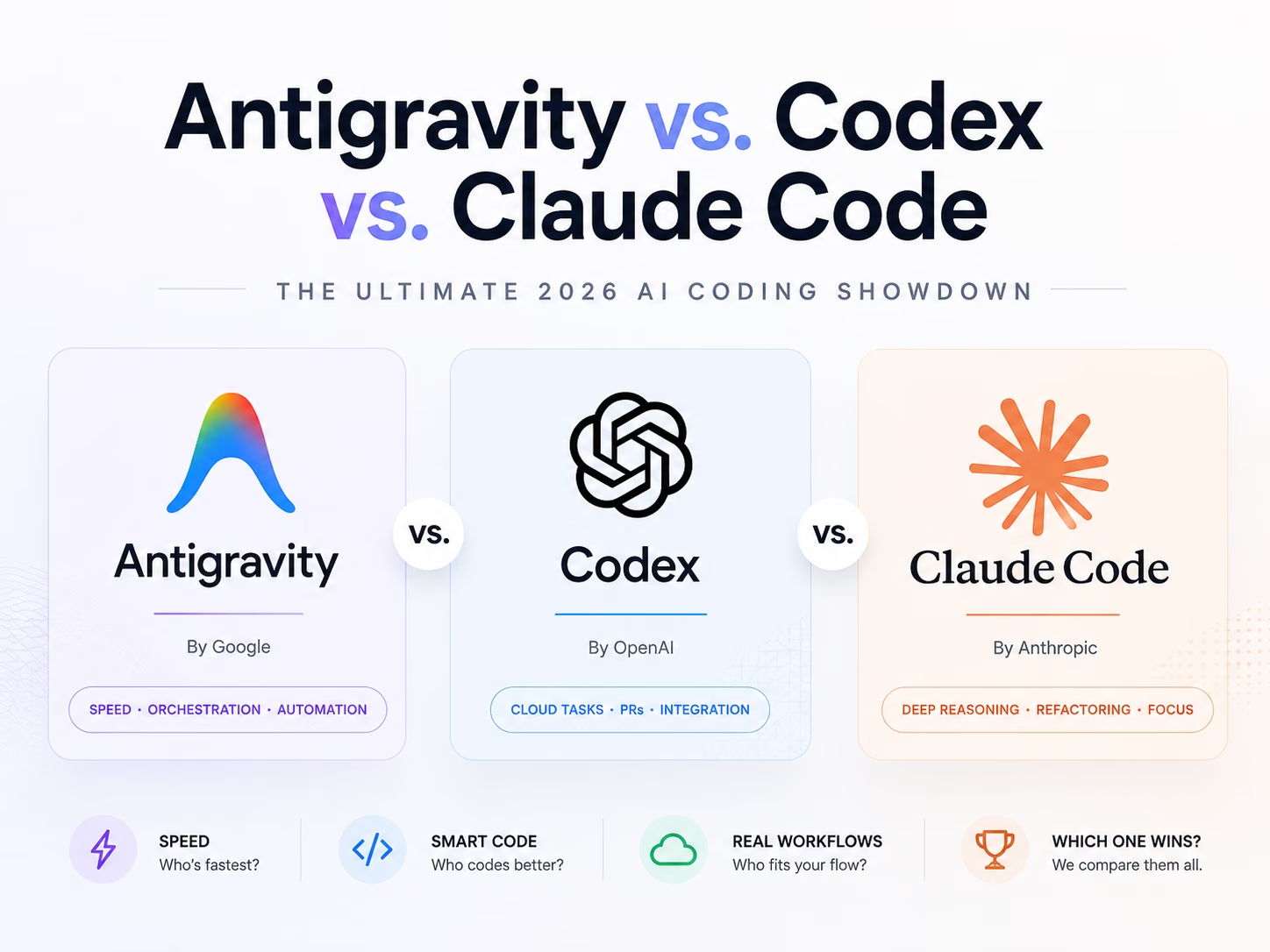
Three companies. Three philosophies. One question every developer is asking in group chats, Reddit threads, and Slack channels right now: which AI coding agent should actually get my $20 a month (or my $200, if you’re feeling spicy)?
If you blinked sometime between late 2025 and mid-2026, you missed a genuine arms race. Google rebuilt its agentic IDE from the ground up and renamed it twice. OpenAI quietly turned Codex into a cloud-native engineering teammate that opens its own pull requests. And Anthropic kept doubling down on the “one really smart agent in your terminal” bet with Claude Code.
They all promise the same headline: describe what you want, and the AI will plan it, code it, test it, and hand you a working result. But how they get there — and who they’re actually built for — is wildly different. Let’s break it down, tool by tool, then settle the “who wins” question once and for all (spoiler: it’s complicated, and that’s actually good news for you).
The 30-Second Verdict
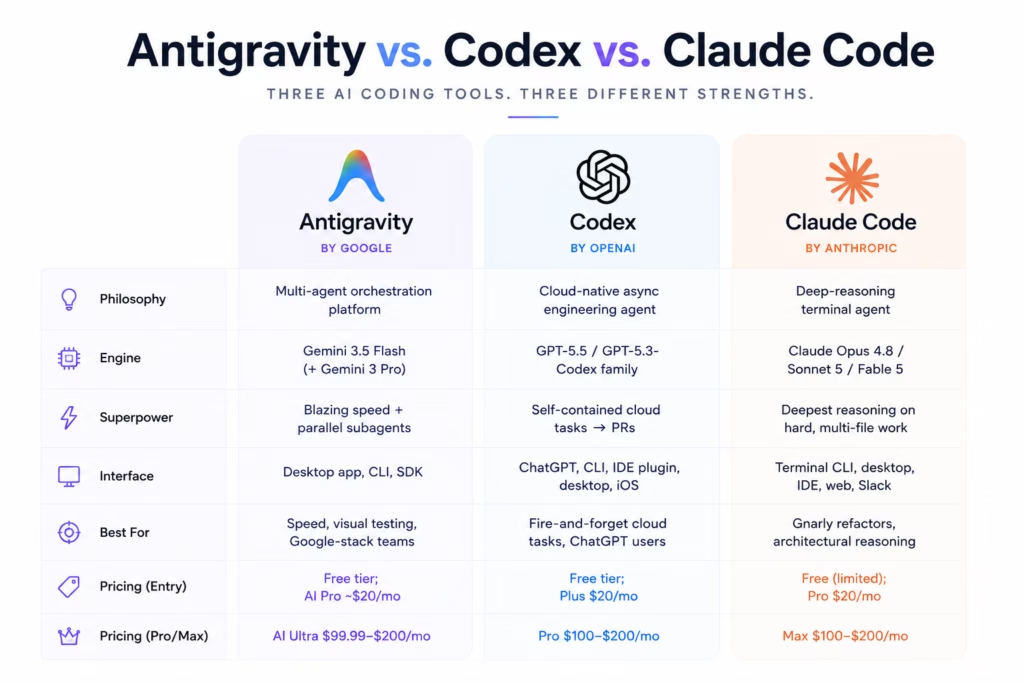
| Google Antigravity 2.0 | OpenAI Codex | Claude Code | |
|---|---|---|---|
| Philosophy | Multi-agent orchestration platform | Cloud-native async engineering agent | Deep-reasoning terminal agent |
| Engine | Gemini 3.5 Flash (+ Gemini 3 Pro) | GPT-5.5 / GPT-5.3-Codex family | Claude Opus 4.8 / Sonnet 5 / Fable 5 |
| Superpower | Blazing speed + parallel subagents | Self-contained cloud tasks → PRs | Deepest reasoning on hard, multi-file work |
| Interface | Standalone desktop app, CLI, SDK | ChatGPT, CLI, IDE plugin, desktop, iOS | Terminal CLI, desktop, IDE, web, Slack |
| Entry price | Free tier; AI Pro ~$20/mo | Free tier; Plus $20/mo | Free (limited); Pro $20/mo |
| Power-user price | AI Ultra $99.99–$200/mo | Pro $100–$200/mo | Max $100–$200/mo |
| Best for | Speed, visual/browser testing, Google-stack teams | Fire-and-forget cloud tasks, ChatGPT users | Gnarly refactors, architectural reasoning |
If you only remember one thing from this post, remember the table above. Now let’s get into why each row is true.
Meet the Contenders
Google Antigravity 2.0: The Speed Demon
Antigravity started life in late 2025 as Google’s answer to the agentic-coding wave, and by the time Google I/O 2026 rolled around in May, it had been rebuilt almost entirely. Gone is the old single-app, VS Code-style layout. In its place: a standalone desktop app for orchestrating agents, a brand-new Go-based CLI that officially replaced Gemini CLI, an SDK for building custom agents, and “Managed Agents” you can spin up with a single Gemini API call.
The signature move is multi-agent orchestration. Instead of one model doing everything sequentially, a manager agent breaks your request into subtasks and hands them to specialized subagents running in parallel — one writes components, another configures the backend, a third opens a headless browser and visually tests the result. Google’s flashiest demo had 93 subagents build the core of a working operating system in about 12 hours, for under $1,000 in compute, and then generated missing device drivers on the fly when a Doom clone wouldn’t boot.
The engine behind most of that speed is Gemini 3.5 Flash, which Google claims runs roughly four times faster than rival frontier models — around 289 tokens per second by some independent measurements. That speed is genuinely addictive once you’ve felt it: plans start executing before you’ve finished reading the confirmation prompt.
Where it shines:
- Startling raw speed, especially for scaffolding and greenfield builds
- Native browser-based visual verification (an actual subagent tests your UI)
- Deep hooks into Google’s own stack: Firebase, Android, AI Studio, Google Cloud
- Scheduled/cron-based agent tasks and live voice input
- A genuinely generous free tier for casual use
Where it stumbles:
- The 2.0 relaunch had a rocky start — an auto-update briefly stripped the built-in code editor without warning, and splitting the product into separate IDE and agent apps broke some existing installs
- On harder, multi-file reasoning benchmarks, independent testing has put Gemini 3.5 Flash a step behind Claude’s top model
- Google hasn’t published Antigravity-specific benchmark numbers, so you’re partly trusting the demo reel
- Enterprise compliance paperwork (SOC 2, HIPAA, FedRAMP specifically for Antigravity’s execution environment) was still catching up as of mid-2026
Think of Antigravity as the developer who types 200 words a minute and is usually right — thrilling to watch, occasionally needs a second pass.
OpenAI Codex: The Cloud-Native Delegator
Quick disambiguation, because this trips people up constantly: the “Codex” from 2021 that powered early GitHub Copilot is dead and gone. The current OpenAI Codex, relaunched in mid-2025 and now running on the GPT-5-Codex model family, is a completely different animal — an autonomous software engineering agent that reads your whole repo, edits across multiple files, runs tests in an isolated sandbox, and opens a pull request for you to review.
The mental model that matters: Codex isn’t autocomplete, it’s delegation. You hand it a self-contained unit of work — “add pagination to the orders API,” “upgrade us to React 19” — and it goes off into its own cloud container to do it, completely separate from your local machine. You can fire off several of these in parallel and go get coffee. Each task gets its own sandboxed environment and comes back as a clean, reviewable diff.
Codex lives everywhere OpenAI has a presence: the ChatGPT web app, a Rust-built CLI, IDE extensions for VS Code, Cursor, and Windsurf, a desktop app, and even a mobile presence. For lighter tasks, you can drop down to GPT-5.4-mini to stretch your usage limits; for heavy agentic work, GPT-5.5 or GPT-5.3-Codex take over.
Where it shines:
- The cleanest “fire and forget” workflow of the three — genuinely good for parallel, background delegation
- Sandbox isolation means an agent going rogue can’t touch your real machine
- Broadest surface area: web, CLI, IDE, desktop, mobile, even a Chrome extension for parallel background work
- Deep ChatGPT ecosystem integration if that’s already part of your daily workflow
- A real free tier and a genuinely useful $8/month “Go” plan for casual users
Where it stumbles:
- OpenAI switched from simple per-message pricing to token-based credit billing in April 2026, and a lot of users found the new system genuinely harder to predict — a big multi-file task can burn 5–9x the credits of a small edit
- No hooks system and a thinner customization layer compared to Claude Code
- Locked entirely to OpenAI’s own models — no mixing in other providers
- Output can vary noticeably between runs of the exact same prompt, which is frustrating when you’re trying to reproduce a result
Codex is the contractor you hand a spec sheet to and check back on in an hour — less hand-holding, more “here’s your PR, boss.”
Claude Code: The Deep Thinker
Claude Code takes the opposite bet from Antigravity: instead of racing through tokens, it spends more compute per token, thinking through project rules, dependencies, and edge cases before it touches a file. Anthropic runs it on the Claude model family — currently topped by Claude Opus 4.8, with Claude Sonnet 5 as the fast, cost-efficient default and the new Mythos-tier Claude Fable 5 available for the hardest jobs. All three of Anthropic’s top-end models ship with a full 1-million-token context window, meaning genuinely large codebases can fit in a single working session without constant re-summarizing.
That deliberateness shows up in the numbers that matter most for real engineering work: on SWE-bench Pro — the benchmark built specifically to stress-test complex, multi-file, real-world bug fixes rather than toy problems — Claude’s top model has consistently posted the highest scores among the three tools discussed here.
Under the hood, Claude Code has quietly become one of the most extensible agents on the market: a persistent CLAUDE.md memory file that accumulates project-specific rules over time, a Plan Mode that drafts an approach before writing code, subagents, skills, hooks for intercepting lifecycle events, native MCP (Model Context Protocol) support for wiring in external tools, and a newer “Dynamic Workflows” feature that splits big jobs across parallel subagents — Anthropic’s own answer to Antigravity’s orchestration model.
Where it shines:
- The strongest track record on hard, multi-file, real-world engineering benchmarks
- Genuinely deep customization: hooks, skills, subagents, and a memory file that gets smarter about your codebase over time
- Runs everywhere a developer actually works: terminal CLI, desktop app, VS Code, JetBrains, the web, even Slack
- 1M-token context as standard on top models, so large monorepos don’t need to be chunked
- Native binaries and a lean terminal-first experience that plays nicely with any other tool in your chain
Where it stumbles:
- Historically the slowest raw token throughput of the three — it thinks more, so it types less per second
- Usage-limit frustration has been a recurring community complaint, and Anthropic has had to make repeated adjustments (raising 5-hour limits, then later splitting automation/agentic usage into its own separate credit pool)
- The top-tier Max plans ($100–$200/month) are pricier than the equivalent power-user tiers from OpenAI and Google
- Less flashy out of the box — there’s no “watch 93 agents build an OS” demo moment; the value shows up in code quality over time, not spectacle
Claude Code is the senior engineer who asks one more clarifying question before touching the payment system — slower to start, but you trust what lands in the PR.
Head-to-Head: Who Wins at What?
Speed
Antigravity, and it isn’t close. Gemini 3.5 Flash’s raw output speed is roughly four times faster than the other two on independent benchmarks. If your workflow is scaffolding, prototyping, or generating a lot of boilerplate fast, this is where you’ll feel the difference immediately.
Complex, multi-file reasoning
Claude Code. On the benchmarks specifically designed to catch subtle, cross-file dependencies — the kind of bug that “looks fixed” but breaks something three files away — Claude’s top model has kept a consistent lead. This is the difference between a refactor that works and one that almost works.
Parallel, hands-off delegation
Codex. Nothing beats firing off five isolated cloud tasks and getting five clean pull requests back an hour later. If your ideal workflow is “assign work, review diffs,” Codex’s sandboxed-container model is purpose-built for exactly that.
Visual / UI-heavy work
Antigravity, thanks to its dedicated browser-testing subagent that can visually inspect what it just built. Claude Code and Codex can both work with screenshots, but Antigravity’s live-verification loop is more built-in.
Customization and extensibility
Claude Code. Hooks, skills, subagents, MCP servers, and a persistent memory file give power users a deeper toolbox for shaping exactly how the agent behaves on their codebase.
Best value for casual/solo use
Roughly a three-way tie. All three now sit around $20/month for a serious entry-level plan (Claude Pro, ChatGPT Plus, Google AI Pro), and all three offer some kind of free tier. The real cost differences only show up once you scale into heavy, automated, or agentic-at-scale usage — at which point token-based billing on all three products can get expensive fast, so watch your usage dashboards regardless of which you pick.
Enterprise / ecosystem lock-in
Depends entirely on what you’re already using. Deep in Google Cloud, Firebase, or Android? Antigravity slots in natively. Already paying for ChatGPT Enterprise? Codex is the path of least resistance. Want a model-agnostic agent that plays well with any IDE or CI pipeline you throw at it? Claude Code’s terminal-first design is the most portable of the three.
Is There an Absolute Winner?
Honestly? No — and treating this as a single-champion contest is the wrong question in 2026.
Six months ago this might have been a cleaner fight. Today, developers who’ve spent real time with all three tend to land on the same conclusion: these aren’t mutually exclusive tools, they’re specialists. A common pattern emerging across dev teams right now is running two of these side by side — Claude Code in a terminal pane for the gnarly, high-stakes refactor; Antigravity or Codex handling the fast, parallel, lower-risk grunt work in the background.
If you genuinely need to pick just one, here’s the honest breakdown:
- Pick Claude Code if: you care most about correctness on hard problems, you live in the terminal, and you want the deepest customization layer.
- Pick Antigravity if: speed and visual/UI verification matter most to you, you’re building fast and iterating faster, and you’re already living in the Google ecosystem.
- Pick Codex if: your ideal day looks like delegating a stack of self-contained tasks and reviewing PRs, and you want the widest range of surfaces (web, CLI, IDE, mobile) tied to one account.
The AI coding tool market moved from “which model is smartest” to “which harness fits how I actually work” faster than almost anyone predicted. That’s a genuinely good problem to have.
Frequently Asked Questions
Is Claude Code better than Codex for beginners? Not necessarily “better” — Codex’s ChatGPT-based interface and generous free tier make it an easier on-ramp for people who’ve never touched a terminal. Claude Code rewards developers who are comfortable working command-line-first.
Which tool is cheapest for solo developers? All three have workable free or ~$20/month entry tiers. Actual monthly cost depends far more on how much agentic/automated usage you run than on the sticker price of the plan.
Can I use more than one of these tools together? Yes, and plenty of developers already do — there’s no technical conflict. Since all three read and write to the same files on disk (or in your repo), you can hand off between them freely.
Which tool has the best benchmark scores? On SWE-bench Pro, the benchmark most focused on complex, real-world multi-file engineering tasks, Claude’s top model has held a consistent lead. On raw output speed, Google’s Gemini 3.5 Flash inside Antigravity leads by a wide margin. Benchmarks change fast in 2026, so treat any specific number as a snapshot, not gospel.
Do these tools work with existing IDEs like VS Code? Yes, all three offer VS Code integration in some form — Claude Code and Codex both ship dedicated extensions, while Antigravity’s IDE component is VS Code-derived.
Prices, benchmarks, and feature sets for all three tools are moving targets in 2026 — check each vendor’s official pricing page before you commit to a plan.